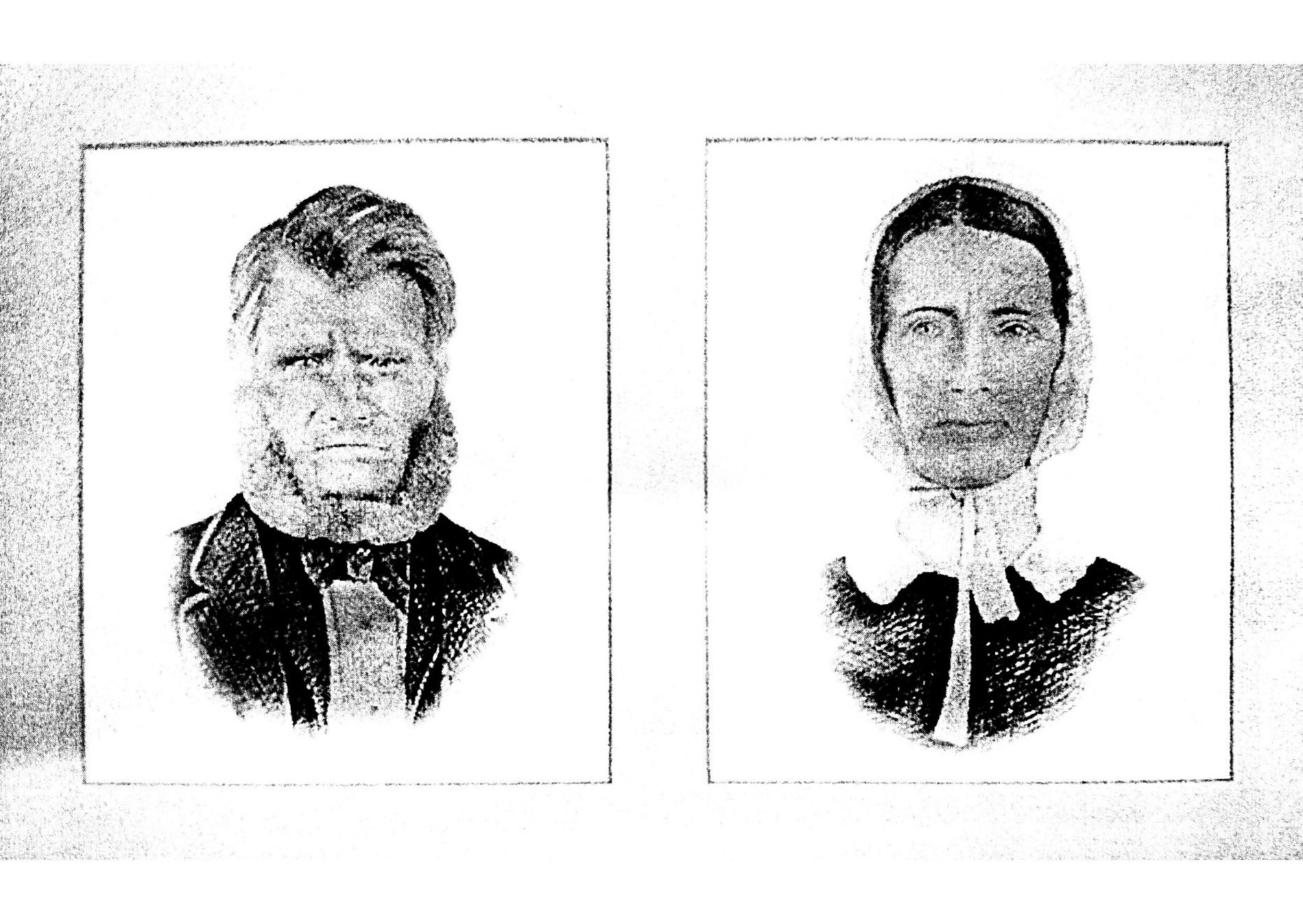
The Tazewell branch of the Gillespies originated with Thomas Gillespie, who came to the Colonies from Scotland and got involved in the Revolutionary War. He was at the Battle of Kings Mountain, and from the back of a tree, he shot and killed a British soldier. After the war, he was hired by a farmer named Barns in what is now known as The Cove. Being a likeable fellow and an honest and upstanding farm hand, he married one of Mr. Barns' daughters.
My Grandfather, George William Gillespie
One of this couple's descendants was George William Gillespie, my grandfather. He went West to seek his fortune, and he and a friend did very well. I was told that George William was a Pony Express rider.
George William was a great admirer of Thomas and Alexander Campbell, who came from Scotland and started the Christian Church (Disciples of Christ). In 1862, he married Barbara Emmons Gillespie (a first cousin) and settled down in the Clinch Valley of Tazewell County.
George William and a man named Barns had a store named Barns and Gillespie, which was located in a small place named Liberty, between Pounding Mill and Richlands.
He purchased land from Pounding Mill to Claypool Hill and, with others, secured mineral rights to the mountainous land in Tazewell County and Buchanan County in the Pocahontas area. He bought a house from a judge on about 40 acres of land in the town of Tazewell on a knoll overlooking the town. He then moved his family from Liberty to Tazewell.
George and Barbara had eight children. The children's names, were Robert Kavanaugh ("Bob"), Olivia Louise ("Oll"), Mary Amanda ("Mame"), William Thomas ("Will Tom"), Sallie, Barnes, David Clinton ("Jake"), and Margaret Bowen ("Mag").
Uncle Bob's Family
I knew Aunt Oll and Uncle Bob the best, because I spent a lot of time in the summer on their adjoining farms just below Pounding Mill. It is my belief that my grandfather, George William Gillespie, gave one farm to Bob and the other farm to Aunt Oll when each of them got married.
Bob was the oldest child of George William and Barbara. He had the prettiest horse, the horse with curly brown hair. Bob lost one of his legs at a railroad crossing in Cedar Bluff. When I was very small, I saw Uncle Bob take off his artificial leg. That was very startling to me.
Uncle Bob had married Kate O'Keeffe, who died before I was born. They had nine children: Fred O'Keeffe, James Samuel (Jim Sam), John Wharton (called "Bigun" because of his size), Olivia Katherine (Ollie Kate), Mary Barnes, Robert Felix, Harvey George, Jessie, and Thomas David.
Bob's oldest son was Fred, who ran the farm after Bob's accident.
Jim Sam went to VMI. Afterward, he returned to the farm and married Elizabeth Ziegler from Richlands.
John Wharton graduated from the University of North Carolina Law School. He joined my brother, Charles Pepper, in Dad's office in Tazewell. He married Virginia Buston, who was our next-door neighbor when I lived in the house in Tazewell where I was born. They had one daughter, Kate O'Keeffe, who married George Williams, an engineer from Tazewell.
Olivia Katherine, known as Ollie Kate, taught me to dance to a Victrola in Uncle Bob's farmhouse. She married James Hunter of Pounding Mill, who was with the railroad. They later lived in Bluefield, WV. Mary Barnes married Harry Ward and moved to Bolton Landing, NY, near Lake George.
Jesse became a doctor and married a psychiatrist, Joseph Merin. The two of them moved to New York City and practiced there.
Robert Felix, called "Rofee," became a doctor and was in practice in Lebanon, VA, for many years. He was well thought of by the people in the Lebanon area. He married Mary Jessie from Lebanon.
Harvey George lived near Blacksburg, VA, and attended VPI. He married Barbara Emmons ("Boonie") Hurt and moved to her family farm in Pounding Mill. They had two children, Harvey George, Jr. and Olivia Hurt. Harvey married Martha Gertrude Croft. He made the genealogical table that John Wharton had on the wall in his house in Tazewell and which Harvey updated and brought to the 1998 family reunion. Olivia married Albert James Graham, Jr.
Thomas David was the youngest of Uncle Bob's family. When he was a baby, the family referred to him as the Papoose because of the way his older sisters carried him around. This was later shortened to Poose. He was one year older than I, and we were great buddies when I spent much time on the farm in the summer. Poose attended VPI. He married Janice Steele of Tazewell, a very close friend of mine. Poose was in the real estate business in Tazewell.
Uncle Bob did not marry again, but I was told that he had a lady friend at one of the neighbor's, and he rode over to see her. I was afraid of him, but he treated me kindly and even paid me 75 cents a day to hoe corn and haul hay shocks (small haystacks).
Aunt Oll's Family
Aunt Oll married George Bascomb Hurt and lived south of Pounding Mill, just below Claypool Hill, on the farm adjoining her brother Bob's farm. When I stayed at Aunt Ollie's, she had an old horse with one eye for me to ride.
The Hurts had six children. George Jr. managed the farm for Aunt Ollie. Jim Bob became an engineer and went into the coal business.
Mary and Kate Hurt were twin girls. Mary Hurt taught piano in Tazewell. She stayed at our house before we moved into Granddad's house. She tried to teach me piano —with very poor results. Mary married J.E.B. Stuart, the confederate general's grandson. Kate married A. M. Young, a Postal Service worker from Seattle.
Margaret graduated from Bethany College and married an English professor there named Roberts. I always called him "Prof Roberts" my first year at Bethany College. Margaret had not married at that time. She was teaching school in the Town of Bethany.
David ("Dave") attended Hampden-Sydney College for one year. With a little political help from Uncle Will Tom and Dad, Dave received an appointment to the Naval Academy in Annapolis, where he graduated after four years. After graduation, he chose the submarine service. He married Constance Wickham, and they had three sons, David, Jr., Thomas, and Jonathan. During World War II, the Japanese captured his submarine and he spent a long time in a Japanese prison camp. After the war, he returned to Annapolis and on a trip to Tazewell he died in a hunting accident.
When I was an intern in Baltimore, Dave, my brother Pep, and I attended the Army-Navy game in Philly. I was the designated driver. We drove to
Annapolis, where Dave and his wife had a house. I remember that Dave had bought a new vacuum sweeper, and he showed us how he could use an attachment to catch flies.
Aunt Mame's Family
Mary Amanda married Hervey Peery Brittain, who was treasurer of Tazewell County, and respected and trusted by everyone. One of his children was Rufus, or Britt, who attended Hampden-Sydney College, then started working at a coal camp at Jewel Ridge. When he found out what he was earning and noted what the doctor at the camp was earning, he decided to go to medical school. He graduated from the University of Virginia Medical School. In the meantime, he married Elizabeth "Lizzo" Roberts. He and Lizzo went to Seattle, where he interned at a clinic that had been established by a graduate of UVA. They drove back to Virginia in a Model T Ford, and Britt became a doctor at the Jewell Ridge coal camp. Britt, Pep, and Dave Hurt were close friends, as well as first cousins.
Britt and Lizzo had two children, Hervey Peery (Pete) and Elizabeth (Bettie). Pete graduated in medicine from the Medical College of Virginia in Richmond. He died from a gunshot wound in Tazewell. Their daughter, Bettie, graduated from the University of Virginia Law School, where she met and later married a fellow law student, William Allan ("Pete") Johnston. Pete
and Bettie settled in Winchester, VA, where he continues to practice law. Bettie retired from law some years ago. They have two sons who live near Onancock on the Eastern Shore.
Lizzo was killed in an automobile accident while leaving the highway going to Onancock. Britt later married Dr. Mary Elizabeth Johnston ("Mary Lib.") Her father, Dr. P. D. Johnston, delivered me and nearly all the children, both black and white, in Tazewell. Britt and Mary Lib had set up a hospital in Tazewell in the Copenhaver house. Dr. Copenhaver was a dentist who filled a lot of my teeth.
Another of Peery Brittain's children was Olivia Katherine Brittain, called Ollie Kate. She taught school in Tazewell and made us all "toe the mark."
Sally Brittain graduated from Bethany College and married Mark Lewis. They had two boys and lived on a farm between Bethany and Wellsburg. They were very kind to me when I was at Bethany.
Barbara B. Brittain married Horn St. Clair. He was a foreman at the coal operation town, War, WV. Buddy and I visited them one summer. I remember how the creek that ran through the town was black from coal dust. They had one son, Alexander Gordon, called A.G.
Mame died when George Robert (Buddy) was born. He was taken care of by his older sister and by my mother, his Aunt Ruth. Buddy was a real good friend of mine. He was four years older, but we played together. We also worked together in Bastian at the Virginia hardwood lumber camp, when Buddy drove his brother Britt's Ford.
Buddy was a senior at Bethany College when I entered my first year. We were both members of the Beta fraternity. Bud was good at math and card games. He graduated from the University of Virginia Law School the year I entered medical school. He returned to Tazewell and set up an office to practice law. Bud married Mary Taylor Barns from the Cove. They had one son.
Aunt Sallie
I never knew Sallie, as she only lived to be 16, dying in 1890. She was never married.
Uncle Will Tom's Family
William Thomas (Uncle Will Tom) married Sara Louise Harman. They had one child, Anita. Uncle Will Tom followed granddad as president of the
Tazewell National Bank. He married a second time. Anita married a Mr. Fleet, who established a drug store in North Tazewell, where they lived.
Uncle Jake's Family
David Clinton Gillespie (Uncle Jake) married Josephine Brittain, sister of Uncle Peery Brittain. We called her Aunt Jo. Uncle Jake studied math in Germany and was professor of math at Cornell in Ithaca, NY.
Uncle Jake had a large yard and in it a pitch-and-putt golf course. When Uncle Jake visited us, we had to get rid of all cats, because he could not stand to have one near him. Aunt Jo and Uncle Jake spent a lot of time in the summer in Tazewell. They built a bungalow on a hill above Aunt Ollie's farm.
Josephine, or Aunt Jo as we called her, was a very proper person and expected us youngsters to behave properly. One time, members of the family were visiting with Aunt Jo in the living room of the Brittain house. One of Pep's dogs, a weimaraner, came into the room and promptly went over and peed on Aunt Jo's leg. I was not there, but I learned that it caused quite a stir.
Aunt Jo had a new Buick. Once she, my mother (Ruth), Bud, and I drove to Ithaca. Aunt Jo drove, my mother sat in the front seat, and Bud and I sat on
the back seat. Aunt Jo would let Bud or me drive some, but she had to tell us what to do. We drove by Bethany to pick up Gus Miller. We got lost going to Bethany. Mother asked a farmer the directions to Bethany, and he said, "Just follow your nose." Mother said, "If I do, I will be in your house." After finding our way to Bethany, we went on to Washington, DC, for the education of us two boys. However, it was hot, and all Bud and I wanted to do was jump in a pool somewhere.
Aunt Mag's Family
Margaret (Aunt Mag) was the youngest of George W. Gillespie's children.
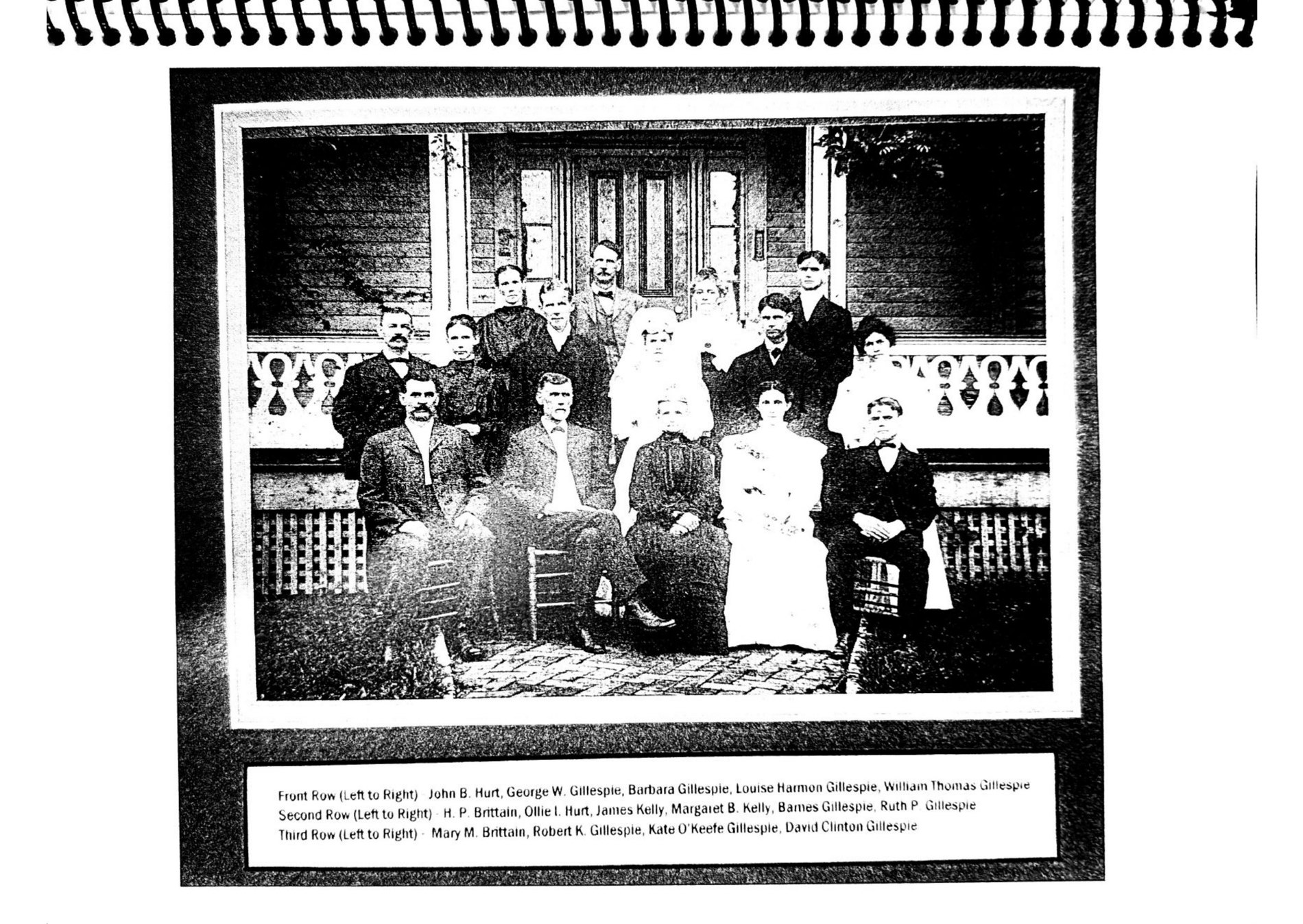
Aunt Mag married James Kelley, who was a highway engineer. The picture of the wedding party, taken on the porch of Granddad's house, is the picture that my daughter, Margie, had enlarged that now hangs in the Tazewell Library.
The Kelleys moved to Sioux Falls, SD. They had one child, William, called Bill. The marriage broke up. When Bill got to be college age, he and Aunt Mag moved to Bethany and had a house there where I lived with my cousins Bud Brittain and Margaret Hurt the first year I attended Bethany College.
Bill Kelley was president of the Beta Theta Pi Fraternity during his senior year at Bethany. He married Mary Carman, whose family lived in Bethany. Bill worked for the RCA Corporation, and they moved to New Jersey. Bill and Diane had three children: Margaret Ellen, Sarah Carman, and Bill, Jr. Sarah organized the 1998 Gillespie reunion in Tazewell.
My Father, Barnes Gillespie, Sr.
My father, Barns Gillespie, was born in Liberty, a small town in the Clinch River Valley. He was apparently named for the store, Barns and Gillespie. He attended a prep school, in Tennessee I believe. He then attended Bethany College, where he was on the baseball team. He graduated magna cum laude. After Bethany, he graduated from the University of Virginia Law School. He set up practice with Mr. Ed Greever, and they had offices in the second story of a building across Main Street from the courthouse, the firm of Greever and Gillespie. Barns added an "e" to his name to make it Barnes. In 1901, he married a girl from Rural Retreat, VA. Her name was Ruth McDowell Pepper, daughter of Dr. Charles R. Pepper, for whom the soft drink was named.
Charles R. Pepper graduated from the University of Virginia Medical School in 1854. He served in a hospital in Bristol, TN, during the Civil War. Ruth was born in Bristol. Dr. Pepper moved to Rural Retreat, where he established
a practice, making house calls on horseback. He had a drug store with a soda fountain. He and his clerk made up a soft drink, using cherries. The drink was very popular with the citizens of the town. The clerk left Rural Retreat and went to Waco, TX. He manufactured the drink, received a patent for it, and named it Dr. Pepper. The drink has become famous over the years. It was rumored that he was enamoured of Ruth, but that is hearsay, as Ruth was quite young when he was in Rural Retreat.
My mother, Ruth McDowell Pepper Gillespie, was born in Bristol, TN, on the border with Virginia. She grew up in Rural Retreat on Dr. Pepper's farm. She attended "finishing schools." I was told, I think by Aunt Jo, that Ruth was a "prom trotter," which means she went to many proms at the local colleges. She may have met Barns at the UVA dances.
Mother had a friend named Royster from Norfolk. He became professor of pediatrics at the University of Virginia Medical School and may have been helpful to me in getting in and graduating from medical school.
Barnes and Ruth had a house in Tazewell, next door to the Bustons. Mr. Buston had a grocery store in town. They had three children, Virginia (Gin), Harry, and Jack. Gin married John Wharton Gillespie, and Harry married Craig Ward. Jack and I were the same age. Barnes and Ruth had three
children, Charles Pepper, born in 1903; George William, born in 1908; and me, Barnes, Jr., born in 1913. My dad, Barnes Gillespie, Sr. was a hard-working, respected attorney and businessman in Tazewell. He was lawyer for his father, George W. Gillespie, who was a wealthy man.
Barnes was co-founder and first president of the Virginia Hardwood Lumber Company in Bland County. He was a lawyer for the Norfolk and Western Railroad and was influential, I was told, in having the railroad go down the Clinch River rather than down the Cove. He was appointed United States attorney for western Virginia during the Taft administration. He always had a vegetable garden, played tennis, and loved to hunt with his pointer Spot. He never smoked or used tobacco, and drank sparingly if at all — though all of his three boys did drink, at times to excess.
When my granddad, George W. Gillespie, died, Dad inherited the home in Tazewell, which consisted of about 40 acres, a large wooden house, and a onecar garage in front of the house. The garage housed a Buick, in which Granddad and his second wife, Maggie, took Sunday afternoon drives with a "colored" chauffeur. The house had a small front porch where the picture of Aunt Mag's wedding party was taken.
Dad completely renovated the house. He enclosed it with brick veneer and added a sun-porch, a large porch along the front, and a driveway up to and along the side of the house. He built a portico and three-car garage in the back.
Dad suffered greatly from a stomach ulcer, had severe varicose veins, and lost a lot of money and property in the Depression in the early 30s. He killed himself with a shotgun in the barn in Tazewell, while I was at Bethany. I am sure he suffered from severe mental depression.
Uncle Rees's Family
My grandfather, George William, had a brother, Dr. Rees Gillespie, a respected physician in Tazewell. Dr. Rees Gillespie had three children: Rees, (called "Rock"), Berkley, and Vivian. Rock married Lunette Harris ("Miss Nettie") and had one daughter, Lunette. Vivian married Mr. Alexander George Russell, Jr., who was a surveyor. He came from Canada, and mapped coal deposits in the area. They had three children, Eleanor, Alexander George III, called "Buck," and Rees Gillespie, known as "Ceci." Berkley married Francis Greear, and they had two children, Berk, Jr., and Vivian, who was called "Biddie."
Buck and Lunette married each other and had three children, Sandy (Alexander George IV), Lunette, and Shelburne, called Shelly.
Cousin Saunders Gillespie
One of our more colorful cousins was Saunders Gillespie, who had a farm by the railroad and highway near Cliffield, between Tazewell and Pounding Mill. He was the nephew of my grandmother, Barbara Emmons Gillespie. He shipped cattle, and the railroad built a station there with the name Gillespie, after Cousin Saunders Gillespie.
Saunders was a large man and could eat prodigious amounts of food, like a half dozen eggs and rasher of bacon for breakfast. One time Mother and Dad were having dinner with them. Dad was known as a good carver and was carving the ham. Cousin Saunders said, "Barnes, you don't have to cut the ham so thin. It ain't your ham."
One day when Cousin Saunders saw a man riding a horse on his property, he went out and the man gave him some lip. He pulled the man off his horse and threw him over the fence. The man said, "What about my horse?" So he threw the horse over also.
My Elder Brother (Charles Pepper Gillespie)
My brother, Pep, was born in 1903 and was 10 years older than I. When Pep passed the law bar, he wanted to join Jeb Kelley's orchestra and tour Europe
for the summer playing the tenor banjo. But Dad would have none of it. He told Pep to come back to Tazewell and work in his office.
When Dad died, Pep had to take over the home place where Dad lived, the law practice, the extensive business holdings, and both George William and me. John Wharton Gillespie joined Pep in the law office, and he hired an accountant, Harry Dodge, to help him.
Fortunately, Dad left a good and detailed will. The will, of course, provided for Ruth, then divided the estate into three parts, one for Pep outright, one for George William in a spendthrift trust, and one for me, Barnes, Jr., to be delivered when I became 35 years old. I was at Bethany College at the time.
Pep married Marjorie Tower from South Orange, NJ. A lot of family attended the wedding in New Jersey. We had a great time, I think. Britt was best man.
Mother (Ruth), Pep, and Marge lived together in the house in Tazewell. Pep and Marge had a daughter, Jean. After Dad died, Mother developed a severe mental depression. She took a pistol, put it to her head, and killed herself. I was in medical school at the time.
Pep joined the Navy as an advocate (lawyer). He was stationed in Los Angeles, and I believe that he, Marge and Jean stayed in the Beverly Wilshire Hotel. John Wharton and Virginia (Gin) stayed in the house in Tazewell. Jean went to school in Tazewell, California, and Richmond (St. Catherine's). She attended Sweet Briar College. She married George Walker from Bluefield, WV. His father, Wade Walker, Dad, and Pep were friends, and all were in the coal business.
Jean and George had two sons, Pepper and George. George died a few years ago, and Pepper is still living out West. Jean and George sold the place in Tazewell to a judge and moved to Sea Island, GA. Jean died there of a brain tumor.
Before Jean and George sold the house, Marge had built a small house for herself on the property. She lived there for many years until she died in Tazewell of a lung tumor.
"Only"
Pep called me one day when I was an intern at the Union Memorial Hospital in Baltimore. He said, "You're buying a place on the Eastern Shore." Pep and Britt wanted a place on the water to hunt and fish. Pep and Britt had a friend from Hampden-Sydney College named George Mapp who lived in Melfa
on the Eastern Shore. He found an old house on Onancock Creek, which was practically on sale because of the taxes. Pep, Britt, George Mapp, and I each put in $1,500 for the place.
This turned out to be "Only," a home built by Henry A. Wise, who was governor of Virginia just before the Civil War. He was the only governor from the Eastern Shore and "Wise Point," the point of land at the southern end of the Eastern Shore, was named for him. The property was about 10 acres on a bend in the Onancock Creek. It had a large barn and an ice well, where ice was stored underground. The house had four stories, but included only one bathroom. A second was installed in the basement, where we spent most of our time. The family and many friends spent wonderful vacations at Only.
The locals now refer to it as "Only Farm" and it is owned by William ("Pooh") Johnston, son of Bettie and Pete Johnston. Pooh recently built an extensive addition onto the house.
Pep's Death
Pep called one day after I returned to practice in Newport News, and he said he had a mole on his arm and asked if I would take it off. I said yes, and the next day he showed up at the office. I took it off and carried it to the
A pathologist in Newport News made sections of it, studied it, and said it was only a mole.
About 3 weeks later, Pep called me to say that he had little moles around the scar, which had healed well. I knew it was a melanoma, and neither the pathologist nor I had recognized it. I called Mike DeBakey whom I had known at the Naval Hospital in Bethesda; he was from the Memorial Cancer Hospital in New York. He told me to send Pep to him in New York. Pep, Ruth, and Marge went by train; I flew. Mike operated about 7 hours, making a skin graft and dissecting the lymph nodes and channels in the axilla.
Pep lived fairly comfortably for some years. He and Mike became friends. He was sitting in his office when he had a convulsion, caused by a metastasis of the melanoma. Several years later, he died from the cancer.
My Brother, George William
George William Gillespie was born in Tazewell on February 2, 1908. He was named for Granddad. When he was 8 or 9 years old, there was a Scarlet Fever epidemic in Tazewell. He had a bad case of it. Our house was quarantined. He developed otitis media and then mastoid infection and brain abscess. A Dr. Peery from Bluefield operated on him in our home. I was told that I did the same to a teddy bear.
This illness affected his mind, and he did not develop normally. He did not do well in high school. Dad sent him to first to Greenbriar Military Academy for one year, which did not work out, then to Kentucky Military Institute.
After George William returned from Kentucky, Mr. Walker got him a job in a store in a coal camp in Splash Dam, VA. There he married Marie Damron, and they soon had a child named Ruth.
After Dad died, Pep took the money from George William's spendthrift account and bought a large farm in Onancock. I had a patient named Charlie Morgan. I asked him if he would move to Onancock to run the farm and take care of George William, which he agreed to do. George Mapp was sort of the overseer of the situation. There were three houses on the farm. The Morgan family, George William, and Marie moved into one. Pep and Britt put a large deep-freeze on the porch to store fish and game. A farmer named Winslow occupied another house. He had a pony that he would bring for the children to ride. The third house was large, and I think it was originally empty.
George William was a heavy smoker and drank whatever was offered or available. The house they occupied burned down, and they all moved into the large house. Marie had another child, a boy that they named William Thomas, for Uncle Will Tom. They called him Tommy.
Pep set up two trusts in a bank in Bluefield, WV, one for Ruth and the other for Tommy. He made me trustee for them. Ruth married and lived in Las Vegas and in the Los Angeles area. She had five children. She developed breast cancer and died in California. I exhausted her trust paying her medical bills.
George William died of pulmonary and heart complications in a hospital on the Eastern Shore. After Pep died, John Wharton and I became joint trustees for George William, and we sold the farm. Tommy, who had lived in Onancock with George William, married, had a son, divorced, then moved to Cherokee, NC. I have tried to contact Tommy, but have received no response. However, the bank in Bluefield is now turning over the assets from the trust to Tommy.
Barnes Gillespie, Jr.
I was born in the downstairs bedroom of our house in Tazewell on March 12, 1913, and was delivered by Dr. P. D. Johnston. My brother, George William, whom I called "Willum," was 5 years old and Pep was 10 years old. Mother had two brothers and no sisters; now she had three sons. She was sorely disappointed that I was not a girl. However, she did not give up easily. A picture showed me at an early age with long hair and a dress.
Also, Mother was leader of the local Girl Scout troop; I was an unofficial member and was taken on picnics with them. One official member of the troop was Pearl Vail Johnson. She taught school in Texas, married a lawyer named Crenshaw, and was the mother of golfer Ben Crenshaw. Pearl's mother was a Gillespie, a distant cousin.
Childhood Pastimes
Many of my childhood memories center on farm life. Three activities that I especially remember are hauling hay shocks, salting the cattle, and having corncob fights.
Hauling Hay Shocks. After the hay has been mowed and allowed to dry, it is gathered into shocks. These are piles about four feet high. An arrangement of chain and rope is then circled around and under each shock. The arrangement is fastened to the harness of a workhorse, then the horse is driven or, in the case of Poose or me, ridden, and the shock dragged to the stack where it is piled up with pitchforks to make or add to the large stack.
Salting the Cattle. The cattle need salt for proper development. The salt was put into cloth sacks. The sacks were carried on horseback placed on the ground after the top had been cut away near an open pond or water trough. The cattle lick the salt and thereby get the needed sodium chloride. A mountain in Tazewell County is called Salt Lick.
One of the jobs Poose and I had was to ride, usually one of the workhorses, and salt the cattle. There were two kinds of horses. The first were saddle horses, which were housed in stalls in the barn and fed corn and hay from the hayloft. The other horses were workhorses, which grazed in the fields. Most of our riding was done on workhorses.
Having Corncob Fights. Corn was fed to the horses, and the cobs were left in piles in the barn. On Sunday afternoon, the younger boys would choose up sides and have a fight, throwing the cobs at each other. The cobs were soft and did no damage unless they had been soaked in water. Then they were pretty hard.
Tazewell High School
I attended Tazewell High School, walking to school almost every day. The principal, Guy Brown, had been recently married. In some way, the students learned that he liked to kiss the bride's toes. Thus the Tazewell High School Principal came to be known as Guy "Tootsie" Brown.
Three girls from Maxwell, a railroad stop south of Tazewell, drove a car to school almost every day. Their names were Maxwell. One of them named Goldine was right pretty. On George Washington's birthday, we thought we
should have a holiday, so after lunch we got the Maxwell girls to drive us to Bluefield to go to the movies. The principal expelled all of us. Mother had to go to Mr. Guy Tootsie Brown to get me reinstated.
I graduated from high school in 1929. There were 16 in our graduating class, and Mother had the graduation party at our house.
Buddy Brittain was in his third year at Bethany College when I was a senior in high school. He was a first cousin, and I looked up to him. We made a trip to Bethany and visited Aunt Mag and Bill Kelley. After that visit, I decided to enroll in Bethany College.
Bethany College
I traveled by train with the trunk Mother had packed for me, and stayed the first year at Aunt Mag's house with Margaret Hurt and Bud. I was taken into the Beta Theta Pi Fraternity to join Dad, Bill Kelley, and Bud Brittain.
The last three years I lived mostly at the Beta house, which had 8 or 10 brothers living in it. There was a second floor, a screened-in porch with bunk beds, two bathrooms and a "colored" cook who was deaf and dumb. However, I coached him in German. He lived in a small room over the attached garage,
where there was some hanky-panky between the brothers and some of the coeds. My roommate was Wayman Parsons from Paducah, KY. He was a ministerial student, and his father was an alcoholic. He had a Ford and held services in Christian churches in the neighborhood. We formed a fictitious club and initiated boys into the club.
There was an abandoned wooden building just off the campus, and there was talk of it being torn down. We overheard some of the brothers talking about burning it down. Parsons had some gasoline, so we went over and set the building on fire, then ran to the Beta house. Soon there was an alarm and everyone went to see the blaze. We stood in the crowd.
A fire truck from Wellsburg arrived amid shouts that the town was going to burn down. We were shaking in our boots, but never said a word. Although the building burned to the ground, the firemen were able to protect the surrounding houses. Someone told the firemen that some Betas had set the fire. Later some of the brothers were questioned in Wellsburg, but no action was taken.
Parsons married a coed after graduation and became minister of a large church in Cleveland, OH. He and his wife were later killed in an automobile
accident. I told the story of the fire at the 25th reunion that Mary and I attended, but I don't think anyone believed it. I began Bethany College in the fall of 1929. That's when the Great Depression started, and the bottom dropped out of the stock market. My best friend at Bethany was Russell Willis Shoup from Shelby, OH. His only material possession was a trombone, which he played very well. He had a night job operating the telephone for Bethany. One Sunday afternoon (Prohibition was in effect), Shoup and I thumbed rides into Wheeling to drink some beer. We were OK until we caught a ride going into Bethany — with the Bible professor and his wife. The next morning, we received a summons to the professor's office. He gave us a real lecture and said we should be expelled and that the odor in the car made his wife sick. We were concerned, but fortunately nothing happened.
When we graduated, Shoup had no job. There were no jobs available, and he had no way to go to graduate school. I was going to University of Virginia Medical School. I suggested that he come home with me and we form a dance orchestra, which we did. Shoup obtained orchestrations (sheet music for dance orchestras). He was on trombone, Buck Russell on alto sax, I on tenor sax, Ed Gregory on piano, Joe Smith on trumpet, Willum on drums, and Rees Russell on guitar. Pearl Johnson sometimes substituted on piano. The orchestra was called "Snakes Russell and His Blowing Vipers." We played for
dances in Tazewell, Bluefield, and one of the coal towns. We played on the radio in Bristol one time, but were not asked back. We made a little money.
University of Virginia Medical School
That summer I renewed a friendship with a distant cousin, Albert Ritchie Gillespie, who lived on a farm in the Cove. He graduated from Hampden-Sydney and was also a member of the first-year class at University of Virginia Medical School. Al helped me find a room to rent in Charlottesville at a house owned by Miss Virginia May, where he also rented a room. This was very helpful, as I did not know much about the University. The house was within walking distance of the Medical School. I studied and worked harder that first year than I ever had. One of the professors had told us, "Look on each side of you. One of you won't be here next year."
Al and I both joined the medical fraternity, and I lived in the medical fraternity the last three years. My roommate was John L. Guerrant from Boone's Mill, VA, south of Roanoke; his father was a doctor. Many in the class ended up as teachers. Guerrant became the professor of pulmonary medicine at UVA. MacLemore Birdsong, one of my best friends, became a professor of pediatrics at UVA. Marion Humphries became a professor of eyes, ears, nose, and throat (EENT) at UVA, St. George Tucker, professor of medicine at the Medical College of Virginia in Richmond. Victor Marshall became professor of
urology at New York University. Dupont Guerry, in the fraternity but not in my class, became head of ophthalmology at Medical College of Virginia.
Mary Baldwin
Fortunately, I graduated. I obtained a rotating internship at the Union Memorial Hospital in Baltimore. My second year, I was in the outpatient department. A student nurse named Mary Baldwin came in with a skin rash. It was a vitamin deficiency. She was right attractive, so later I decided to give her a break and ask her to go to the movies. She said she could not because she had to wash her hair. This, of course, infuriated me. However, a few days later we did go to the movies and thus started a romance.
We became engaged, then went downtown to a wholesale jewelry shop and purchased a diamond ring. Mary was released from nursing school, and I took a job as a resident physician — the first for them — at Peninsula Memorial Hospital in Salisbury, MD, on the Eastern Shore. While I was there, we made a trip to visit Lillian Hinton, a friend of Mary's in Reedville, VA. We began to have second thoughts about getting married, so we called it off. Mary was readmitted to nursing school, and I went to Salisbury.
In the summer and fall of 1939, I made several weekend trips to Baltimore, and Mary made one to Salisbury. We decided to get married, so Mary went
to the administrator of the nursing school to request permission once more to withdraw. She was told in no uncertain terms that she would not be admitted to the nursing school again. On March 8, 1940, we were married in the Episcopal Church in Baltimore. Pep was best man, and Mary Helen Young (later Mrs. Maynard Putney Smith) was maid of honor. Mary's uncle, Howard B. Baldwin, held a reception at the Llerondale Club. Aunt Jo, Marge, Buck Russell, some Baldwins, and some of our friends from the hospital attended. We took the train to New York and the next day sailed for Bermuda for a 10-day honeymoon at Elbow Beach Hotel.
Janice Jordan, a schoolmate of Mary's, came to the ship and gave us a bottle of champagne. Mary got seasick the first day out. The war was on in Europe, but the German submarines did not bother us. I was served Coca-Cola on the beach at the hotel. The charge was 25 cents, and I thought it was outrageous.
When we returned to Salisbury, we moved into a small house near the hospital for $25 a month furnished. Mary started her golf career. We invited a couple for dinner, and Mary bought a chicken. It was almost a disaster, but the pediatrician and his wife were kind and helped, and we survived. I
wanted to move, and I took a residency in pathology at the Evanston, IL, hospital and fellowship at the Northwestern Medical School for one year.
We drove to Chicago by way of Bethany, playing golf a couple of times along the way. We rented a one-room apartment with a Murphy bed just off the campus of the University. We took our meals at the hospital, and I was paid $100 a month. We made some good friends with the interns, and made evening trips to downtown Chicago. We also bought skates and went iceskating.
Mary took two courses at Northwestern: golf and political science, and also got a job selling hats in a boutique. While we were in Evanston, Mary got pregnant.
Buck Russell called me and said I could come to Newport News, go into general practice with Dr. Guy Amory, and have a job at the shipyard. We decided to accept the offer and move to Newport News.
Before moving to Newport News, we visited our families. Mary took the train to Tazewell and slept for the entire trip. I drove the car to Tazewell, and we went on to Winston-Salem and stayed awhile with the Baldwins. We had two suitcases and a cedar chest. We drove to Newport News and stayed with
Buck and Lunette while we found a house to buy — 238 James River Drive. Pep sent us furniture through one of the coal companies. Judy was born in 1942.
World War II: Africa and Europe
The war was on. I was dissatisfied with my set-up in Newport News. I volunteered for the Navy and was given a specialty rating in general surgery because of my hospital training.
I was inducted into the Navy as a Lieutenant Junior Grade, JG. I was assigned to the USS Monrovia, a new ship that was named for the capital of Nigeria. It was part of the Amphibious Force being put in commission at the Naval Shipyard in Portsmouth, VA. I reported aboard on Christmas Eve of 1941.
After I left, Mary decided to visit Pep and Marge. She notified Marge that she was coming to Tazewell on the train. Mary was 20 years old, pregnant, and sleepy most of the time. Marge met the train in North Tazewell, but Mary did not get off, so she went home. The conductor awakened Mary at Honaker, a small town about 30 miles south of Tazewell. Mary called Marge and told her what had happened and took a bus headed to Tazewell. She fell asleep on the bus, and if Marge and Gin Gillespie had not gotten her off the bus, she would have missed the stop in Tazewell once again.
When I reported aboard the Monrovia, I was informed that I was the only doctor for the ships tied up there. A sailor on another ship had a bellyache. I sent him to the nearby Naval hospital to have his appendix removed by a Dr. Deaver, whose father was a famous surgeon in Philadelphia.
The captain made me beach party doctor. This meant that I was to go with the boats ashore for the invasion to take care of the casualties and send both the dead and wounded back to the ship in small boats. I was sent to the Little Creek Amphibious Base, Camp Bradford. This was January, and we lived in tents. We had beach parties from two ships similar to the Monrovia. The Navy decided that we could not practice tropical warfare in snow and ice, so we were all sent by train to Florida for further rugged beach training. I was issued a Colt 45 pistol.
The senior medical officer on the Monrovia was Commander Robert Gelman, a pediatrician. When he returned from Christmas leave, he had me ordered back to the ship and, thank heavens, out of the beach party because of my surgical training. He was a good doctor, a good boss, and a good friend.
Arriving on board was Dr. James Cuthbert Owens, just out of hospital training at the Ford Hospital in Detroit, to be beach party doctor. Cuth and I became close friends the 18 months we were on board together. The ship
made trips up the Chesapeake Bay so that the small boats could be launched and invade the friendly beaches for practice. Then we left in a large convoy for the Mediterranean and the harbor at Algiers. The whole convoy zigzagged in order to avoid German submarines. A sailor developed appendicitis, and the captain dropped out of the convoy while Cuth and I took out the sailor's appendix.
There was a tremendous armada of ships at the harbor at Algiers. The largest was the British battleship, the King George V. That ship sent a message inviting Americans to attend church services on Sunday. Bob Gilman, Cuth, and I took a small boat and went over. We were piped aboard; the service was held on the top deck. Then we were invited to the admiral's quarters for a drink. We were informed that we should stay 5 minutes. We were served a drink of Scotch, nodded to the admiral, and left. The admiral's quarters were handsomely decorated and occupied a large area in the stern of the main deck.
The invasion ships left in the afternoon. We were told then that we were to invade Sicily after a false run toward the coast of Greece. We were served a steak dinner at midnight. The scuttlebutt was (rumors on ship) that the Germans had cannons on the mountains of Sicily to blow us out of the water. I went to bed, threw up, and went to sleep. The invasion was successful.
General Patton went ashore from our ship. We unloaded our casualties at an army hospital in Algiers. Then we sailed in convoy to Newport News Shipyard for check-up, and the crew went on leave. While there, I was able to see Mary and Judy.
World War II: The Pacific
After that, the Navy ordered the Monrovia to the Pacific, with home base in San Francisco. We took on 500 young and gung-ho marines from the Mid- West. After we rounded Cape Hatteras, the ship rolled and about 400 of the Marines threw up, mostly down in the holds, where they were bunked. It was a mess. We went through the Panama Canal and up the coast to San Francisco. In the meantime, Mary took Judy, age 1-1/2, with a chaplain's wife and drove across country to San Francisco.
We arrived in San Francisco, took on more Marines, fuel, and provisions, and in 12 hours left for New Zealand. Mary arrived to find that the ship had gone. The places to rent had signs: No dogs, no children.
We were alone, not in a convoy. Because of the Japanese submarines, we zigzagged at night. Every sunrise and sunset, the captain gave orders for "General Quarters, man-your-battle stations." We all had to go to our assigned stations. We tied up at the harbor at Wellington, the capital of New
Zealand. and made practice assaults on the beaches. The small boats were launched, and the marines went ashore. The people were very friendly, the food and beer was cheap and plentiful, but there was no ice.
In the meantime, my brother, Pep Gillespie, had joined the Navy as a lawyer, an advocate. He was stationed in Los Angeles, and he, Marge, and Jean were living in the Wilshire Hotel.
Mary looked in the want ads of the Los Angeles paper and saw, "Mother with small child has house available for another wife with small child in North Hollywood." Mary answered the ad and moved in with an English woman who worked at a movie studio and was coaching actors in the proper English for the film, Two Years Before the Mast.
The ship left New Zealand, and we took part in the invasion of Tarawa, a small island strongly fortified by the Japanese. It was a hard battle with many casualties on both sides. This was followed by the invasion of Kwajalein.
After that, we went to San Diego for dry dock. Pep made reservations for Mary, Judy, and me to stay in a suite at the Del Coronado Hotel, located on a peninsula, just across the harbor in San Diego. This was a very plush hotel
with a view of the ocean. The hotel had a children's playground and provided a sitter for Judy. After a few days, I got leave and we went to North Hollywood. After a delightful time, I returned to the ship, and we took part in the invasion of Saipan.
World War II: Naval Medical Center
I had reached 18 months of sea duty, so when a young surgeon from Atlanta came aboard to replace me, I welcomed him with open arms. I packed my footlocker and traveled to San Francisco on the small carrier, The Thetis Bay. Cuth Owens was with me, and the Navy put us up at a hotel, where we waited for 10 days for orders. Mary took Judy and drove to Winston-Salem. I got orders to the Naval Medical Center in Bethesda, MD, and Cuth got orders to a dispensary in Tennessee. I took a commercial plane to Winston-Salem to join Mary and Judy.
We drove to Washington, down Wisconsin Avenue, to the brand new Naval Medical Center in Bethesda that FDR had designed with a tower, and Mrs. Roosevelt had a pool in the yard. We rented a house in Rockville, about 10 miles west of the Medical Center. Mary was pregnant. I reported in, and was assigned to the Waves, a surgical ward with 50 beds. The Chief of Surgery was a neurosurgeon from the Mayo Clinic, Captain "Wink" Craig. He became a good friend.
Our twins, Anne and Margie, were born six weeks prematurely on January 2, 1945. Mary's mother sent Bessie Link from Winston-Salem to help with the twins. Bessie lived with us and took care of the children and the house for nearly 20 years.
Neighbors, Mary Lou and Bill Chambers, kept Judy awhile. A pediatrician from the Navy advised us to take the twins home, as they were both in one incubator because the place was so crowded. This we did and fed them by bottle every 3 hours night and day. This was a hard time for all of us, but especially for Judy, as the twins took everybody's attention. An assistant to the commanding officer of the Medical Center, Roy Brooks, was a friend and neighbor. I told him about Cuth Owens's job at the dispensary in Tennessee. He said, "I will take care of it." The next thing I knew, Cuth arrived to be on the surgical staff at the Center. It's not what you know, it's who you know.
After the War
We returned to 238 James River Drive, where Mr. Tom Hundly of Hundly and Applewhite had taken care of renting the house while we were away, I in the Pacific and Mary in California. The shipyard gave me back my job, and I set up practice in surgery, gynecology, and obstetrics. We made a bedroom for
Bessie out of the garage and bought one of the first washing machines, a Bendix from Tazewell.
In August 1949, we bought a home on the James River, 200, from Mrs. Roger Terry. The sale price was $30,000, and our attorney was Bill Allaun of the law firm of Newman, Allaun, and Downing. Things were pretty slow in Newport News, so we sold a lot on the river to Bob Tolley for $10,000.
Mary and I, Judy, Anne, Margie, Bessie, Pooch the dog, and a stray cat that the grocery boy from Dave Sewards' had left with the groceries moved to 200. The cat went back to 238, and Mrs. Palmer, a former neighbor, adopted it. Pep got us some more furniture from North Carolina through one of the coal companies. Bessie occupied the third floor. It was August of 1949, and hot. One night, all six of us slept on the screened porch.
The three girls attended Hilton Elementary School. Judy and Margie graduated from Warwick High School, Anne from Hampton Roads Academy. Judy tried nursing at Duke, but it did not turn out; however, she met Geoff Myers there. She ended up graduating from Salem College in Winston-Salem, NC. Anne graduated from Queens College in Charlotte, NC, and Margie graduated from Mary Baldwin College in Staunton, VA.
After Mary's death in 1995, I continued to live at 200 until its sale in October 2000. I've taken a few trips, and one of the best was the Gillespie reunion in Tazewell in 1998, which I attended with my three daughters. It was good to see the family home, as well as the house where I was born, Tazewell High School, Tazewell National Bank, Tazewell Christian Church, and other familiar landmarks. It was also good to be a part of that large group of friendly relatives that gathered — all descendents of my grandfather, George William Gillespie.
I am now living in a retirement home, The Chesapeake, 955 Harpersville Road, Newport News, VA 23601. My telephone number is 757-223-1745.