Across an ocean and through early America—from the Wepawaug, where our earliest American ancestors made a home, to the Cowpasture, whose waters flow onward to the James.
Begin with Nana and Grandad—Mary Baldwin Gillespie and Barnes Gillespie Jr., MD—then move through their parents, children, siblings, spouses, and the wider family one generation at a time. The viewer combines Grandad’s memoir with Randy’s maternal Ancestry tree while keeping imported claims visibly marked for verification.
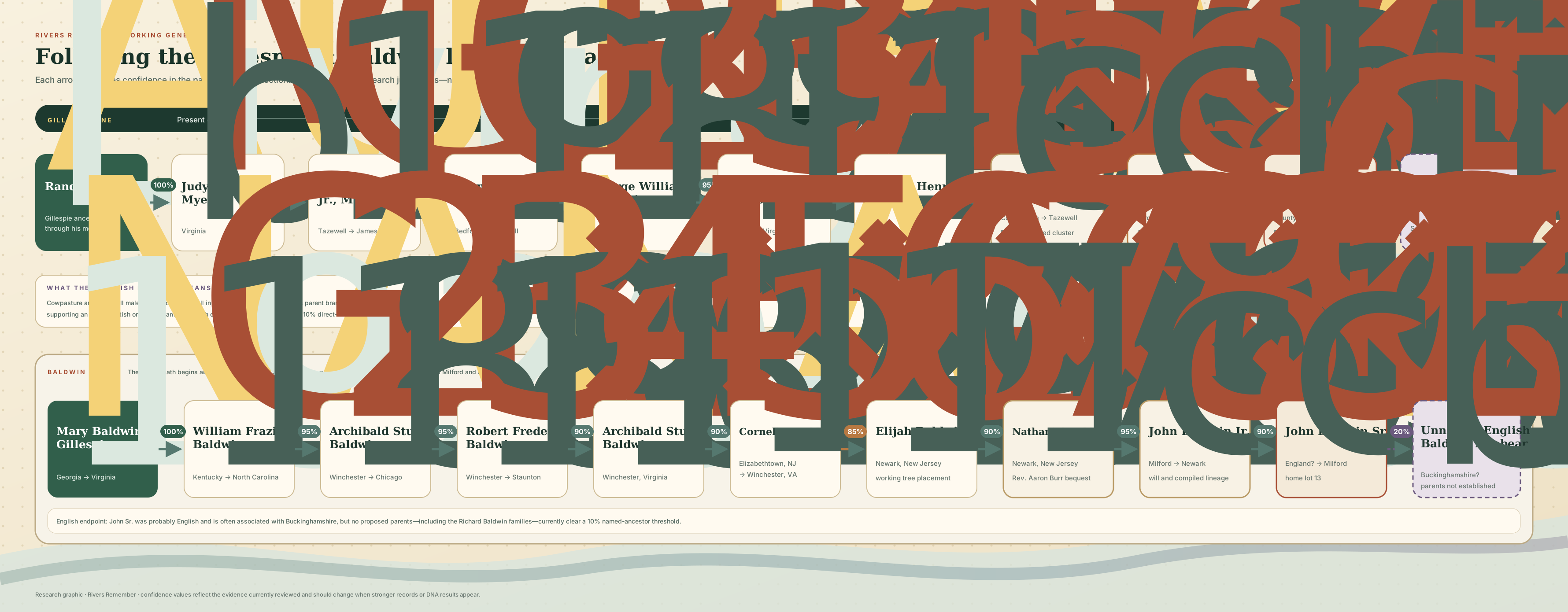
Begin with Randy and Judy in the shared center. Judy’s parents—Barnes Gillespie Jr. and Mary Baldwin Gillespie—open the two branches: Gillespie above and Baldwin below. Every arrow carries the current confidence estimate for that relationship.
Scroll sideways to explore the full lines. Percentages are research judgments—not statistical probabilities—and will change as stronger records or DNA evidence emerge.
Scottish DNA context: Cowpasture and Tazewell male-line descendants fall in Y-DNA branch I-FGC51755. Its parent branch shares older ancestry with a tested Scottish Gillespie line, supporting a Scottish origin without identifying a named direct ancestor. The two Falkirk Williams are not included.
Baldwin endpoint: John Baldwin Sr. was probably English and is often associated with Buckinghamshire, but no proposed parents—including the Richard Baldwin families—currently clear the threshold for inclusion as named ancestors.
Chapter one
The earliest arrivals
The honest version of a family story is often more interesting than the polished legend. These are the earliest documented or reported arrivals on the direct maternal branches now under study. When the ocean crossing itself is unknown, the date marks the earliest surviving American record—not a claimed immigration date.
DocumentedProbableOpen question
1639
John Baldwin Sr.
England probable → Milford, Connecticut
Milford’s early records place John Baldwin among the settlers there in 1639, making him the earliest documented direct ancestor currently found in America. His ship, English parish, and parents remain unknown; the current reviewed lineage continues through his son John Jr. to Newark.
A Virginia patent placed William on 400 acres near Timber Neck Creek by 1642. A later Maryland lawsuit described a bond made in England about twenty years before 1652/53. The evidence establishes his presence in Virginia by 1642, not the date or ship of his Atlantic crossing.
Documented in VirginiaEnglish origin probablesources
By 1654
William Barton
England probable → Maryland
William Barton—the grandfather of Elizabeth Barton, wife of Captain Thomas Smoot—was in Maryland by 1654. A later family will associates the Maryland Bartons with relatives in Warwickshire, but it does not prove the immigrant’s birthplace. William Batten, previously grouped here, was a collateral relative rather than this direct ancestor.
Maryland presence supportedWarwickshire association probablesource
c.1706
The Wiseman household
Wales tradition → Philadelphia, Pennsylvania
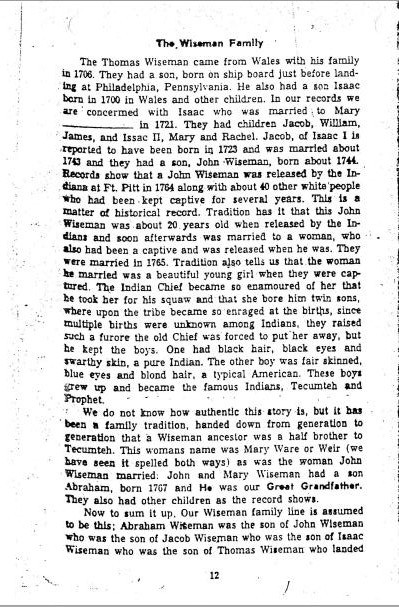
A preserved Wiseman family history says Thomas Wiseman came from Wales with his family in 1706 and that a son was born aboard ship shortly before they landed at Philadelphia. The imported maternal tree reaches this family through Nana’s Barley line, but the voyage account and direct-line placement still need original-record confirmation.
Family tradition—verifyDirect line provisionalsource
1746
William & Mary Gillespie
Ulster hypothesis → Cowpasture River, Virginia
The 1746 survey of William’s 320-acre Cowpasture tract is the family’s earliest firm American anchor; the patent followed in 1761. Neither record proves when William crossed the Atlantic. A 1721 County Armagh baptism is a serious hypothesis, while the link from William to Thomas Gillespie of Tazewell remains probable rather than proved.
These are the people at whom each direct maternal branch currently stops. They are arranged by reported birth year—not by certainty. A reviewed endpoint may extend beyond Randy’s current Ancestry tree when published evidence supports it; every such extension is labeled by confidence.
The First to Arrive: John Baldwin Sr.
John Baldwin Sr. was probably born in Buckinghamshire, England, around 1610–1615, but his parents, parish, ship, and exact crossing date remain unknown. Milford’s early records place him in the Connecticut settlement in 1639, making him the earliest documented direct ancestor currently found in America.
John and his probable first wife, Mary Camp, raised a large family beside the Wepawaug. Their home stood at lot 13. The direct line continues through their son John Jr.—about five years old in 1646—who later carried this Baldwin branch from Milford to Newark, New Jersey.
A place on the map
Milford in 1646
Lot 13 today — reconstructed, not surveyed: the town record puts a highway on its east edge, John Fletcher’s lot 12 to the north, Francis Bolt’s lot 14 to the south, and other lots to the west. Aligned with the Wepawaug and the old Town House, this places it on the west side of today’s West River Street, approximately between the civic-center grounds and West Main Street. The Google Maps link opens at the middle of that likely area; it is not a claim about a present parcel boundary.
The nearby historic house: the Eells–Stow House at 34 High Street is about half a mile south. It is geographically close, but it was built later on Wharf Lane property and is not John Baldwin’s house or part of lot 13. A later owner, Freelove Baldwin Stow, gives it a genuine Baldwin association whose precise relationship to this direct line still needs to be traced.
Other Baldwin households nearby—Richard, Nathaniel, Timothy and Joseph—show a substantial family community, but their precise relationship to this John remains open.
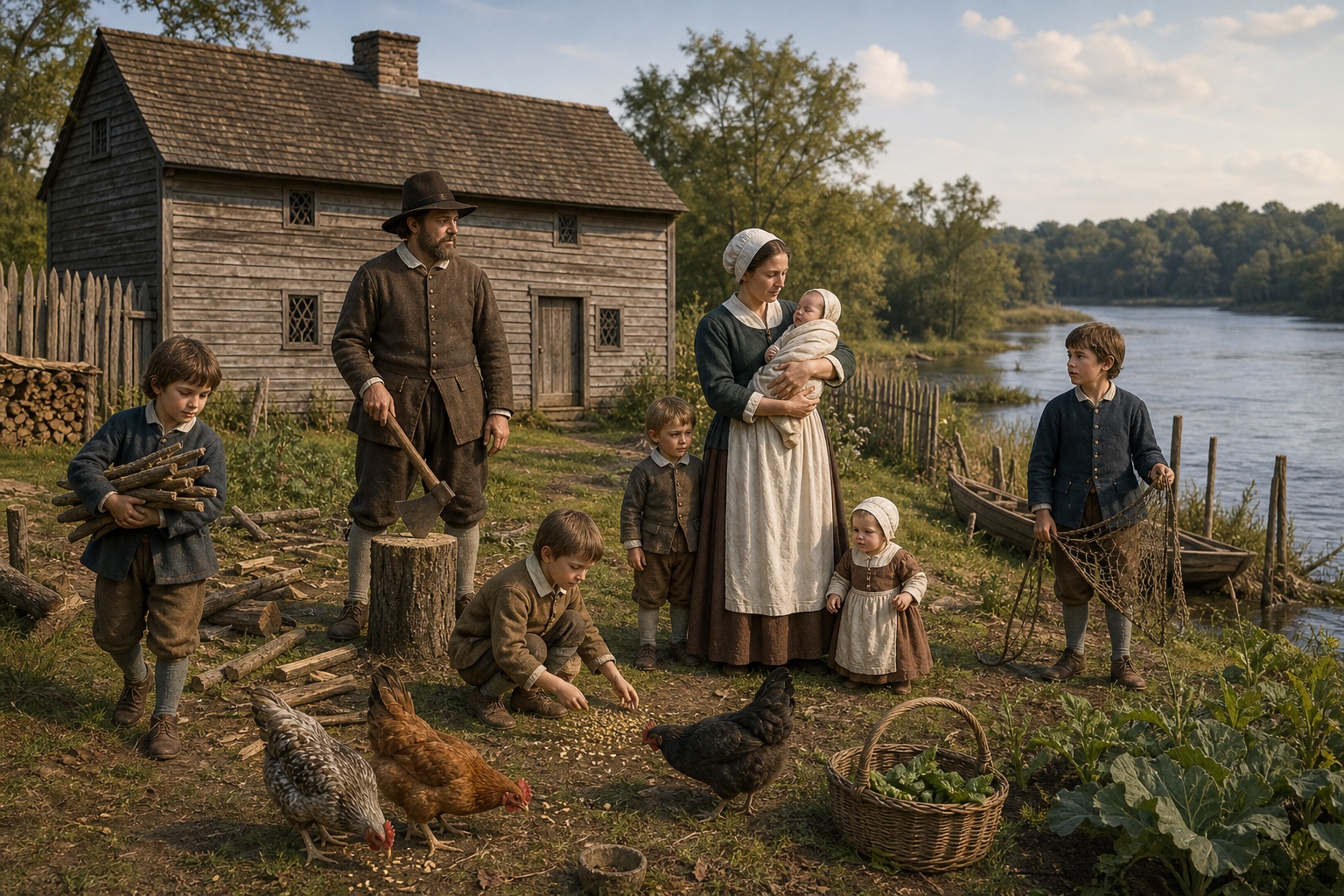
Life on lot 13, imagined around 1651. Hover over—or tab to—the markers to meet John and Mary’s household. The Wepawaug, recorded lot size and neighbors, and family names inform the reconstruction. The faces and precise activities are imagined; the dwelling borrows architectural context from the later Eells–Stow House and is not presented as John Baldwin’s actual house.Mary Camp’s identification as John’s first wife is supported by careful compiled genealogy but is still described by its editors as probable rather than conclusively proved. Ages are approximate.
How to read this: “Supported” marks a reviewed placement; “Ancestry endpoint—verify” marks an imported relationship that still needs independent records. Unknown birth years appear last. This ledger will move backward as evidence earns each new generation.
Chapter two
A map of movement
Most dots mark reported or approximate birthplaces; the Baldwin layer also follows the family’s two major southward steps—from Milford to Newark in 1666, then from New Jersey to Winchester just after the Revolution. Two small friendship markers remain along the Cowpasture as a later coincidence. Lines show migration, generational movement, or geographic connections. Click any dot or line for context.
The map needs an internet connection
The family data is inside this file, but Leaflet and OpenStreetMap tiles load online.
The family’s first Virginia landscape
The Gillespies’ First Home in America
When William Gillespie’s 320 acres were surveyed in 1746, the lower Cowpasture was still a thinly settled mountain frontier. William, Mary and Robert Gillespie appear among the residents named there in a 1756 court dispute, surrounded by families with names such as Scott, Simpson, McMurry, Beard and Arbuckle.
This was part of a much larger migration. Many early settlers in western Virginia were Ulster-Scots—also called Scotch-Irish—Presbyterian families of Scottish background who had lived in northern Ireland before crossing the Atlantic. Large numbers moved from Pennsylvania down the Valley of Virginia during the 1730s and 1740s, following river valleys and taking up farms where water, bottomland and mountain passes made settlement possible.
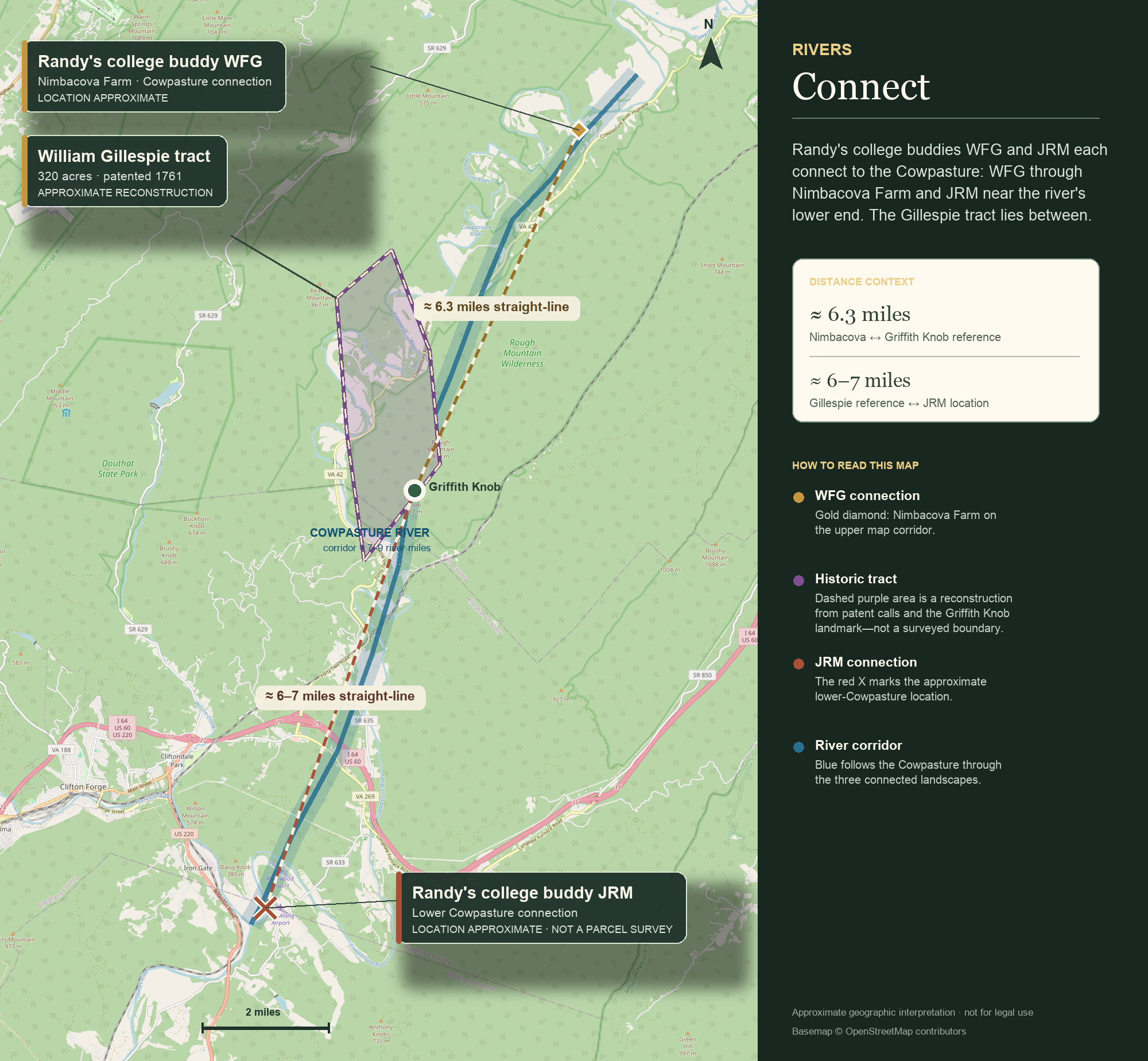
The Cowpasture and Jackson rivers meet near Iron Gate to form the James. That gives the family story a physical continuity: water from the Gillespies’ first known American home eventually passes the James River landscape that shaped Randy’s childhood.
Clifton Forge came later. The modern town lies on the Jackson River, roughly three miles above its meeting with the Cowpasture. Settlement grew there in the nineteenth century around an iron forge, the road over North Mountain and, after the first passenger train arrived in 1857, the Chesapeake & Ohio Railroad.
A later small-world connection
Generations afterward, Randy learned that WFG and JRM also had family connections only a few miles above and below the old Gillespie tract. Their markers remain on the map as a remarkable coincidence—not as the center of the historical story.
The 1761 patent ran northward through four straight calls—222, 168, 254 and 60 poles—then returned “down the various courses” of the Cowpasture. The calls imply a narrow tract roughly two miles long, with the river as its closing boundary. The shape shown here is schematic; the clickable map polygon is an approximate placement near Griffith Knob, not a modern boundary survey.
Title trail: William and Mary Gillespie → Aaron Hughes (1780) → apparently Alexander Simpson (1787). The second transfer should be compared with the original Botetourt deed before the chain is called proved.
The earlier generated PNG was not available in this workspace, so this file includes an original embedded SVG reconstruction instead.
Chapter three
Ancestors worth exploring
A few people whose lives illuminate our family’s place in a larger American story.
01
Dr. Charles Taylor Pepper & the name that traveled farther than he did
Physician Charles Taylor Pepper (1830–1903) practiced in southwest Virginia and served as a Confederate surgeon. His daughter Ruth McDowell Pepper married Tazewell lawyer Barnes Gillespie; their son was Charles Pepper Gillespie.
The family link is real. The familiar claim that Dr. Pepper invented—or definitively named—the soda is not. The Dr Pepper Museum credits Waco pharmacist Charles Alderton with creating the drink in 1885 and says the name’s origin remains unclear.
Family pathCharles Taylor Pepper → Ruth McDowell Pepper → Charles Pepper Gillespie
Born in Tazewell in 1903, he carried both family names. Contemporary alumni notices place him at Washington and Lee and later practicing law in Tazewell; the Virginia Museum of History & Culture lists a portrait file for him (1903–1954).
ConfidenceIdentity and career supported; a fuller biography still needs obituary, census and bar records.
A page preserved with the Wiseman history tells a remarkable family tradition. It says John Wiseman and a young woman were captives among Native people, were released, and married in 1765. The story then identifies two sons the woman supposedly bore while captive as the celebrated Shawnee brothers Tecumseh and Tenskwatawa, the Prophet.
The surviving account candidly concludes: “We do not know how authentic this story is.” Some of its historical language is reproduced in the scan but is not used as modern terminology here.
The tradition is not supported by documented Shawnee history. Tecumseh was born about 1768 and Tenskwatawa about 1775, so they were not twins. Historical accounts identify their parents as the Shawnee warrior Puckeshinwa and Methoataske. The story belongs on Rivers Remember as evidence of what the Wiseman family remembered—not as proof of Native ancestry.
Direct family contextThe imported maternal tree reaches the Wisemans through Nana’s Barley line; that genealogy still requires record-by-record verification.
Born into an established Charles County family around 1660, the younger Thomas married Elizabeth Barton and became sheriff of Charles County in 1703. He should not be confused with his father, Thomas Sr., who died about 1668—or treated as a 1687 immigrant.
Why it mattersA single mislabeled land-index date had turned a locally born Maryland official into an invented immigrant.
Research identifies Isaac Wiseman (1738–1818) as a Pennsylvania militia private on the American side. A 1788 Rockingham record names Isaac, son Samuel and Isaac Jr.; the date is postwar and should not itself be described as a Revolutionary muster.
MigrationBerks County, Pennsylvania → Rockingham County, Virginia → Monroe County, now West Virginia.
William Smoot connected to England
A later lawsuit looks back to an English bond from about this time.
400 acres in York County
William’s Virginia patent anchors the family in the colony.
The household moves to Maryland
Transportation claims later name the family members.
The Cowpasture tract is surveyed, then patented
William Gillespie’s 320 acres sit opposite the Griffith Knob landscape.
The Gillespie story moves toward Tazewell
Thomas and Margaret Bowen’s descendants become a major Tazewell family.
Pepper and Gillespie lines join
Ruth McDowell Pepper marries Barnes Gillespie.
From the family library
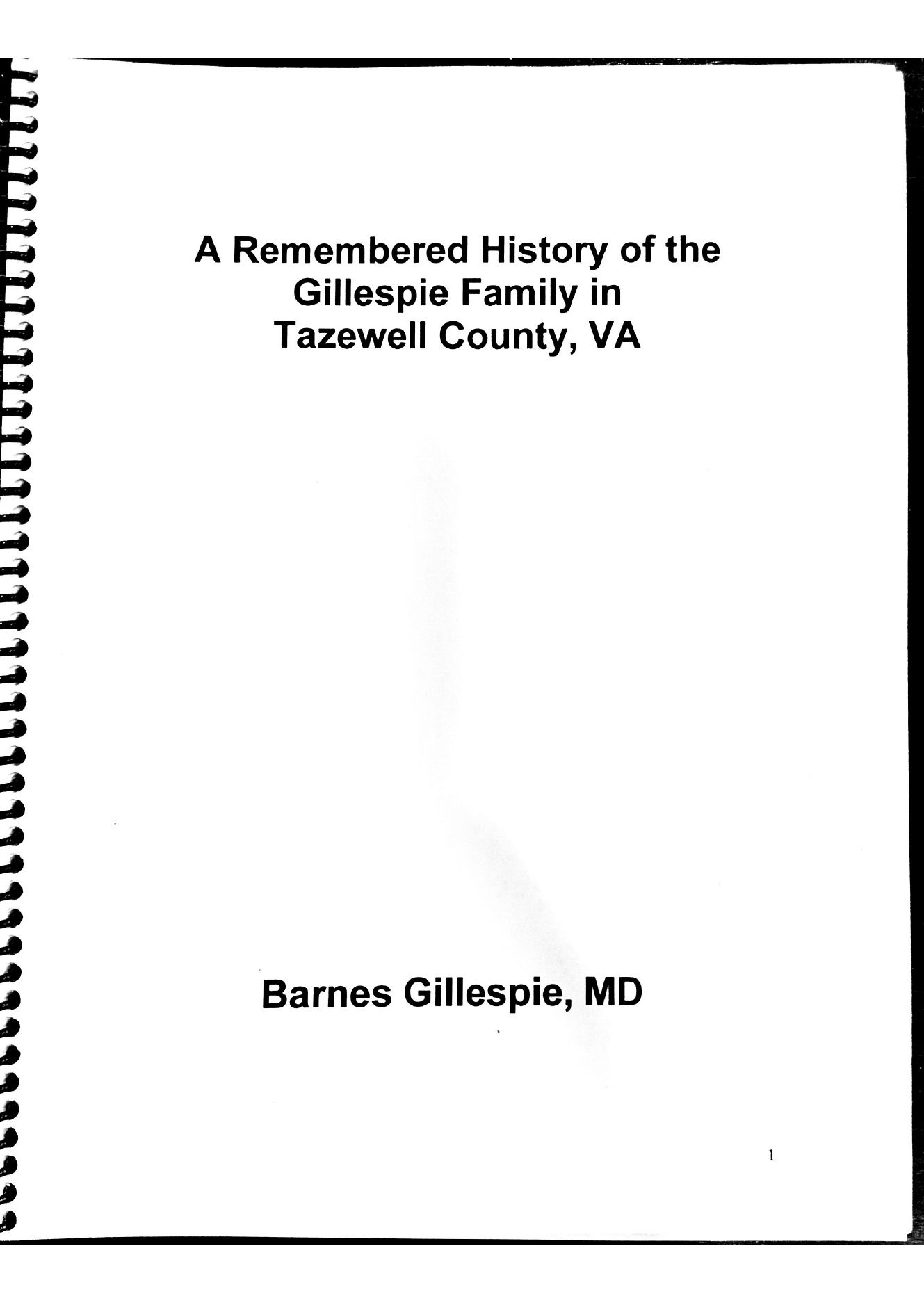
A Remembered History of the Gillespie Family in Tazewell County, VA
by Barnes Gillespie, MD
A firsthand family history written by my grandfather—part memoir, part local history, and part record of the Gillespie generations rooted in Tazewell County.
The new digital edition is fully typed, searchable HTML with a table of contents, adjustable text, night reading, and the original family photographs.
The manuscript is now complete. New photographs replace printed pages 2, 4, and 30 in the archival scan and the typed edition.
A life carried by place
Grandad
Barnes Gillespie Jr., MD, was born in Tazewell in 1913, studied at Bethany College and the University of Virginia, and met Mary Baldwin while he was an intern at Union Memorial Hospital in Baltimore. After a residency in Salisbury, Maryland, they spent a formative year in Evanston, Illinois, before making Newport News—and the James River—the center of their family life.
His medical career was interrupted by service as ship’s surgeon aboard USS Monrovia. The ship carried assault forces through Sicily, Tarawa, Kwajalein, and Saipan. After the war he returned to Newport News, practiced medicine, raised three daughters with Mary, and eventually wrote the memoir that anchors this site.
Tazewell, VirginiaBethany, West VirginiaCharlottesvilleBaltimoreSalisburyEvanstonNewport NewsPortsmouth & Little CreekFloridaAlgiersSicilyPanama & San FranciscoWellingtonHawaiiTarawaKwajaleinSan DiegoSaipanBethesda & Rockville
The geography still folds in on itself. Judy—my mom—was conceived during Nana and Grandad’s year in Evanston, within walking distance of where I live today in Wilmette. Years later, I attended McDonogh School near Baltimore, another place where their young life together had begun.
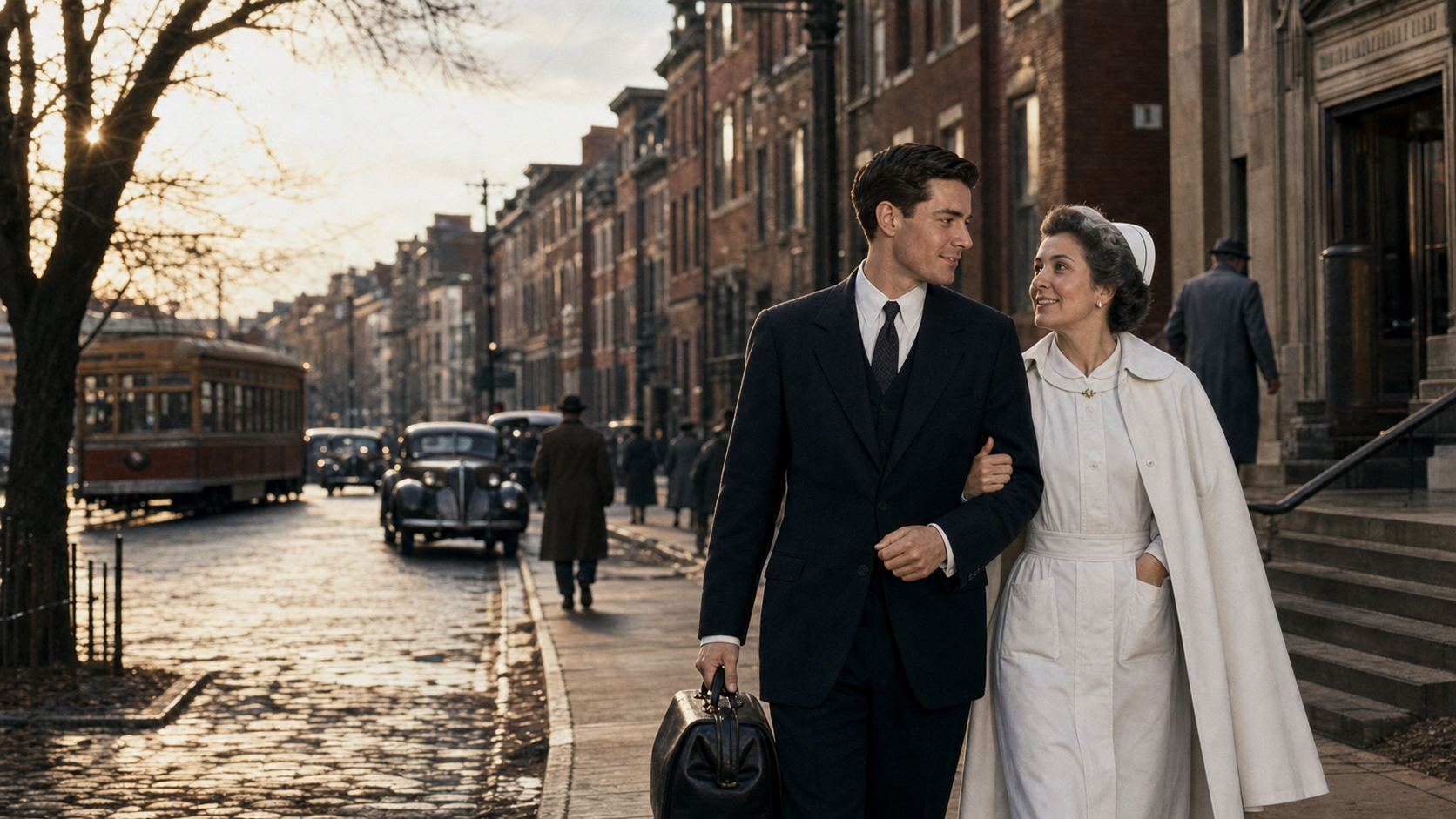
Interpretive reconstruction: young Barnes and Mary in late-1930s Baltimore, where an intern and a student nurse met at Union Memorial Hospital. It is not an historical photograph.
Homecoming · 1998
Tazewell Reunions
“I've taken a few trips (after Mary passed), and one of the best was the Gillespie reunion in Tazewell in 1998, which I attended with my three daughters. It was good to see the family home, as well as the house where I was born, Tazewell High School, Tazewell National Bank, Tazewell Christian Church, and other familiar landmarks. It was also good to be a part of that large group of friendly relatives that gathered — all descendents of my grandfather, George William Gillespie.”
— Dr. Barnes Gillespie (Grandad)
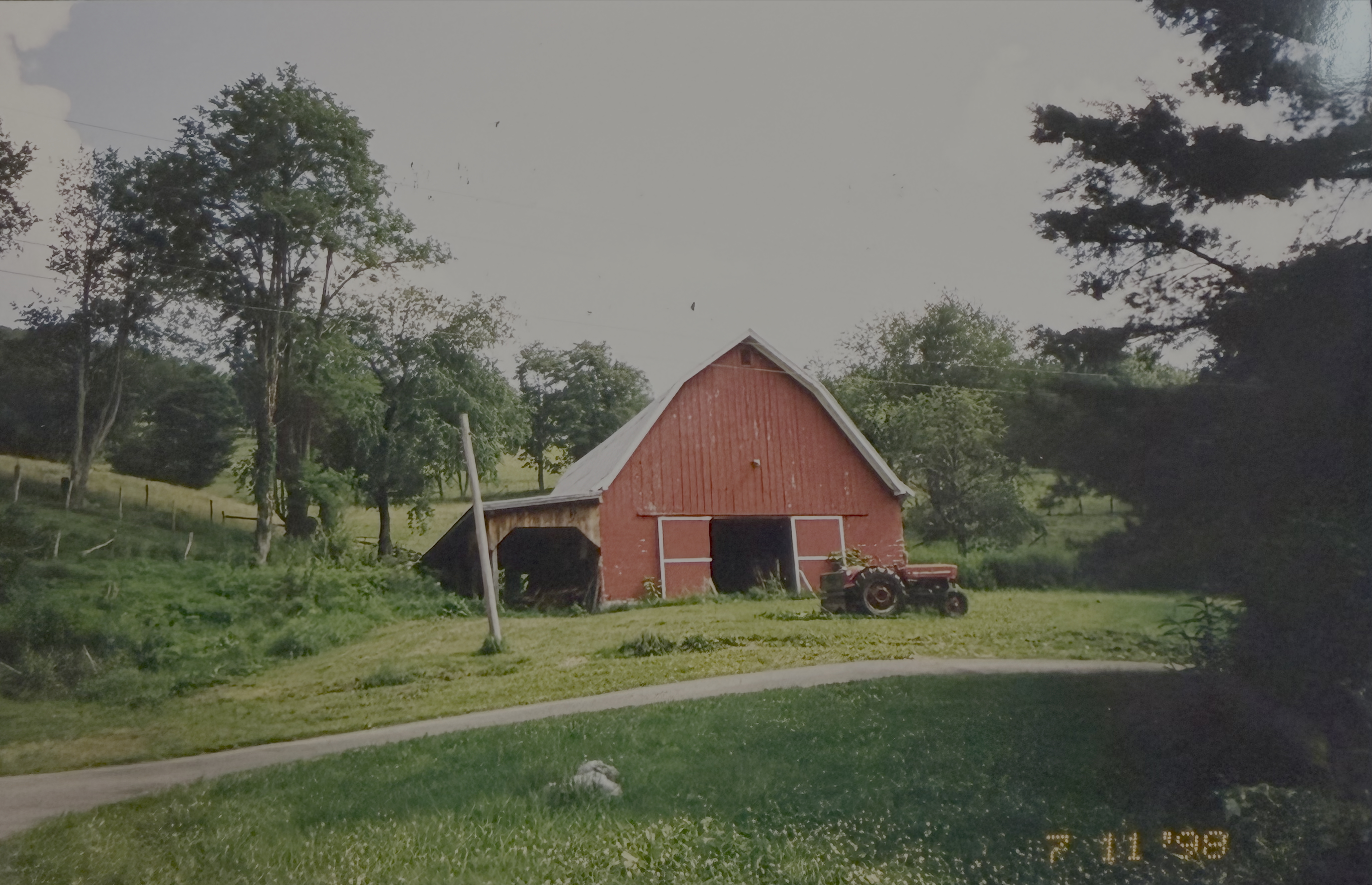
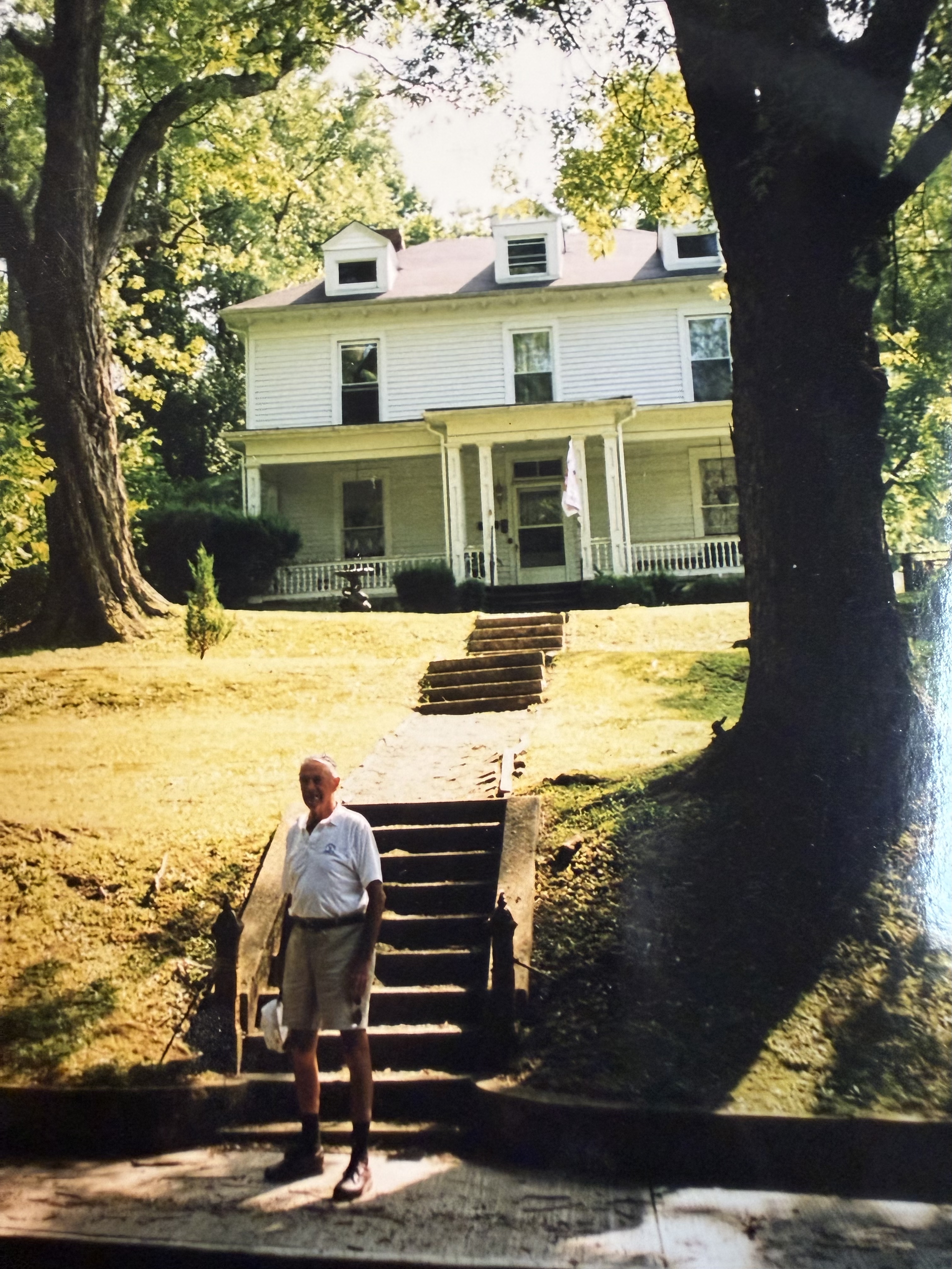
The Red Barn that my mom, my aunts, and later my cousins and I played in.The house where my Grandad was born.
I was born in the downstairs bedroom of our house in Tazewell on March 12, 1913, and was delivered by Dr. P. D. Johnston. My brother, George William, whom I called “Willum,” was 5 years old and Pep was 10 years old. Mother had two brothers and no sisters; now she had three sons. She was sorely disappointed that I was not a girl. However, she did not give up easily. A picture showed me at an early age with long hair and a dress.
Contribute to the Story
More Research is Needed
Family history moves forward when someone recognizes a name, remembers a story, or finds the record everyone else missed. These are the questions where a document, photograph, family Bible, DNA match, or firsthand memory could change what we know.
Help solve these family mysteries
Open question 01
Who gave Dr Pepper its name?
Charles Alderton created the drink in Waco, but the origin of its name remains uncertain. Can you find contemporary evidence that it honored Dr. Charles T. Pepper of Rural Retreat—or another Dr. Pepper—and establish how Wade Morrison or Alderton knew him?
Especially useful: pre-1900 advertisements, correspondence, pharmacy employment records, newspaper accounts, or documents connecting Morrison or Alderton to the Pepper family.
Open question 02
Can we find the Scottish ancestors that are mentioned in family stories?
The Cowpasture records establish William in Virginia by 1746, while a 1721 Armagh baptism remains a serious but unproved lead. Evidence is still needed to connect the two men and carry the family securely toward Scotland.
Especially useful: church registers, passenger or merchant records, wills, land transactions, correspondence, and Y-DNA matches with documented Armagh or Scottish lines.
Open question 03
Who were John Baldwin Sr.’s English parents?
John is documented in Milford by 1639, but his parish, ship, and parents remain unknown. Published claims tying him to Richard Baldwin or Buckinghamshire families have not yet been proved.
Especially useful: English parish records, migration lists, early Milford depositions, probate files, or evidence distinguishing this John from other Baldwin families.
Open question 04
Can the Cowpasture title chain be completed?
William Gillespie’s 320-acre tract opposite Griffith Knob is documented, but the full deed trail—and a defensible modern parcel-level reconstruction—still needs to be assembled.
Especially useful: original Augusta and Bath County deeds, surveys, plats, tax records, neighboring title chains, and locally held maps or abstracts.
Open question 05
Where in England did William Smoot come from?
Records connect William Smoot to England and place him in Virginia by 1642, then Maryland, but they do not identify his parish, first wife, or precise Atlantic crossing.
Especially useful: English court and parish records, shipping material, Maryland depositions, bonds, wills, or records naming relatives on both sides of the Atlantic.
Open question 06
What survives behind the Wiseman captivity story?
The family account says a young John Wiseman was captured and held for several years. It also describes a young woman who was captured separately, bore twin sons while among Native people, and was later released. According to the story, John and the woman met after their releases, married in 1765, and had a son named Abraham in 1767. Later family tradition identified the twins she left behind as Tecumseh and Tenskwatawa, the Prophet—an identification that conflicts with documented Shawnee history.
Especially useful: earlier versions of the account, names for the unnamed woman, family letters or Bible pages, captivity narratives, colonial court or military records, and evidence showing when the Tecumseh identification first entered the family story.
The Ancestry and Descendants of Frederick Tracy Camp and Marion Fee. The carefully edited compiled account identifies the first Milford household’s children and supports John Baldwin Jr. of Newark as a son of John Sr.; it treats Mary Camp’s identification as probable and leaves the elder John’s English parentage unresolved.
F. R. Honey, Milford in 1646. Public-domain 1880 reconstruction published in Edward E. Atwater’s 1881 history; the image identifies John Baldwin among the early household lots.
The Wiseman Family — preserved family-history page. Reports the 1706 arrival from Wales and a child born aboard shortly before landing; it is family testimony awaiting confirmation from contemporary records.
Milford Historical Society — Eells–Stow House. History of the house, the Eells and Stow families, and Freelove Baldwin Stow; the National Register record places the museum at 34 High Street.
History of Medicine in New Jersey. Records Dr. Cornelius Baldwin’s Revolutionary service and states that he migrated to Virginia after the war and died at Winchester in 1826.
National Park Service — Valley Turnpike. Documents the Great Wagon Road connecting Philadelphia with Winchester; this supports a probable corridor, not Cornelius’s exact itinerary.
Family Trails, pp. 70–85. Published compiled genealogy placing Parmelia Gannaway, wife of John Rader, among the children of Gregory Gannaway and Rhoda Robertson; useful but still subject to verification against the original records it cites.
Richard Baldwin Sr. memorial. A useful research lead whose own biographical note warns that Richard’s parentage is not proved; it does not establish a line to the Newark Baldwins.